9 July 2026
Pidyion haben-redemtion of the first born
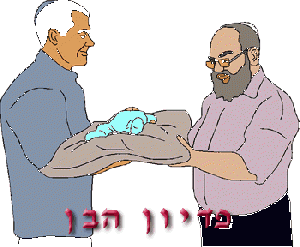
A pidyon haben, or “redemption of the firstborn son,” is a ceremony wherein the father of a firstborn male redeems his son by giving a kohen (a priestly descendent of Aaron) five silver coins, thirty days after the baby’s birth.
The pidyon haben (redemption of the firstborn son) is rooted in the Exodus from Egypt and reflects the Jewish understanding that life ultimately belongs to God. Originally, the Israelite firstborn were consecrated for divine service because they were spared during the Plague of the Firstborn. After the sin of the Golden Calf, however, they lost this privileged status. Since the tribe of Levi, and especially the descendants of Aaron, remained faithful, the priesthood was transferred to them. From that point onward, every firstborn Israelite son was redeemed through the payment of five shekels to a kohen, symbolizing the transfer of this sacred responsibility.
The commandment also serves as a reminder that all possessions and blessings come from God. By consecrating and then redeeming the firstborn, Jewish families acknowledge that even their greatest gifts are entrusted to them by the Creator. As the Maharal explains, because God is the “First Being,” it is fitting that the firstborn be dedicated to Him.
Only firstborn males require redemption. According to rabbinic tradition, the miracle commemorated was the sparing of Israelite firstborn sons during the final plague, while Jewish women were already distinguished by their faithfulness and were not associated with the spiritual failings of Egypt. Additionally, since the redemption replaces the Temple service that firstborn males would have performed before the priesthood passed to the Levites, it applies only to males
Risk of disappearing
The pidyon haben ceremony is becoming less common for several reasons. In many Jewish communities, relatively few families are actually obligated to perform it, since the commandment applies only to a firstborn son born naturally to parents who are both Israelites (not Kohanim or Levites) and whose mother has not previously given birth. As a result, many Jewish families are exempt. Beyond these legal limitations, assimilation, secularization, and declining familiarity with Jewish ritual have led many families to forgo or simply remain unaware of the tradition. In some communities, especially outside Israel, opportunities to learn about or witness a pidyon haben are rare, making it less visible in communal life. Although still observed in Orthodox and many traditional Jewish communities, the ceremony has become increasingly uncommon in liberal and less religious settings, reflecting broader changes in Jewish religious practice and the weakening of intergenerational transmission of ritual traditions.
Bibliography / Sources
https://www.chabad.org/library/article_cdo/aid/652310/jewish/Pidyon-Haben.htm
https://halachipedia.com/index.php?title=Pidyon_Haben
https://www.chabad.org/library/article_cdo/aid/928176/jewish/The-Complete-Pidyon-Haben-Ceremony.htm