3 July 2026
Classical Challah bread recipe
The evolution of challah is important to preserve because it tells a much larger story than the history of a single bread. It embodies the continuity of Jewish tradition, the resilience of Jewish communities, and their ability to maintain a distinct religious identity while engaging creatively with the cultures around them. Every variation of challah reflects a different chapter in the Jewish diaspora, revealing how ritual remained constant even as ingredients, techniques, and local customs.
Ingredients
1 ⅛ cups lukewarm water
1 Tbs dry yeast
1 tsp sugar
4 ½ cups all-purpose flour
2 eggs, beaten, plus 1 whole egg for glazing
½ Tbs salt
¼ cup sugar
¼ cup vegetable oil
poppy or sesame seeds (optional).
Dissolve the yeast in warm water with 1 teaspoon of sugar and let stand for about 10 minutes until frothy.
In a large bowl, beat the eggs with the remaining sugar, salt, and oil. Stir in the yeast mixture, then gradually add the flour until a soft dough forms.
Knead for 10–15 minutes until smooth and elastic. Place the dough in a lightly oiled bowl, cover, and let rise in a warm place for 2–3 hours, or until doubled in size.
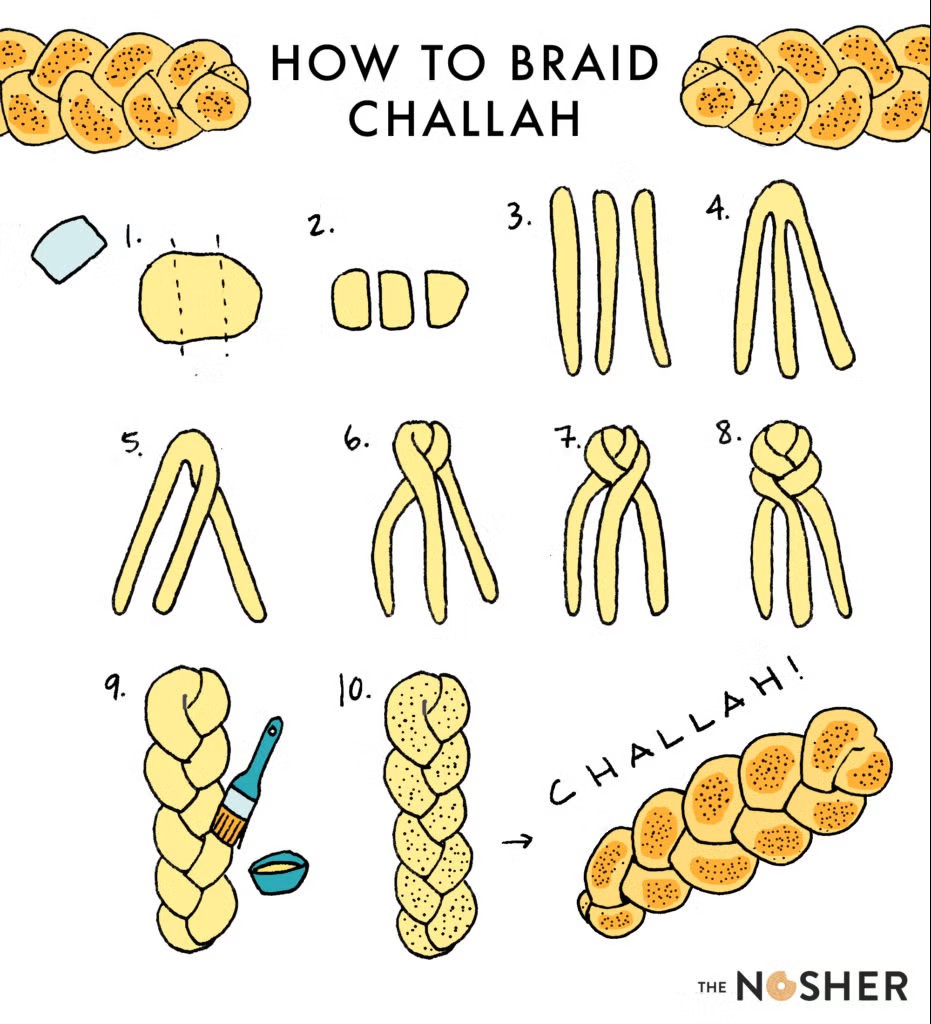
Punch down the dough, knead briefly, divide into two portions, and braid each loaf into the desired shape. Place on a lined baking tray and let rise again for about 1 hour.
Brush with beaten egg and, if desired, sprinkle with poppy or sesame seeds.
Bake at 350°F (175°C) for 25–30 minutes, until the loaves are deep golden brown and sound hollow when tapped on the bottom.
Bibliography / Sources